Every low tide walk starts out the same way: A group of strangers circled up in the parking lot, all eyes focused on the lead who gives a short introduction and safety meeting. Dressed in waterproof shoes, quick-dry pants, and an assortment of hats shielding faces from the sun, the group is ready to go.
Participants get paired with volunteers, and all of a sudden it’s off to the race – or more like a hunt in this case. Looking out towards the horizon, the sun sparkles off the water, and between the sand and the water lies a field of boulders normally covered by a few feet of water. From the shore, they appear unalluring, covered in a dull brown/green seaweed that blends in with the rocks to create what seems like a uniform landscape. Yet, the group sets off for this boulder field.
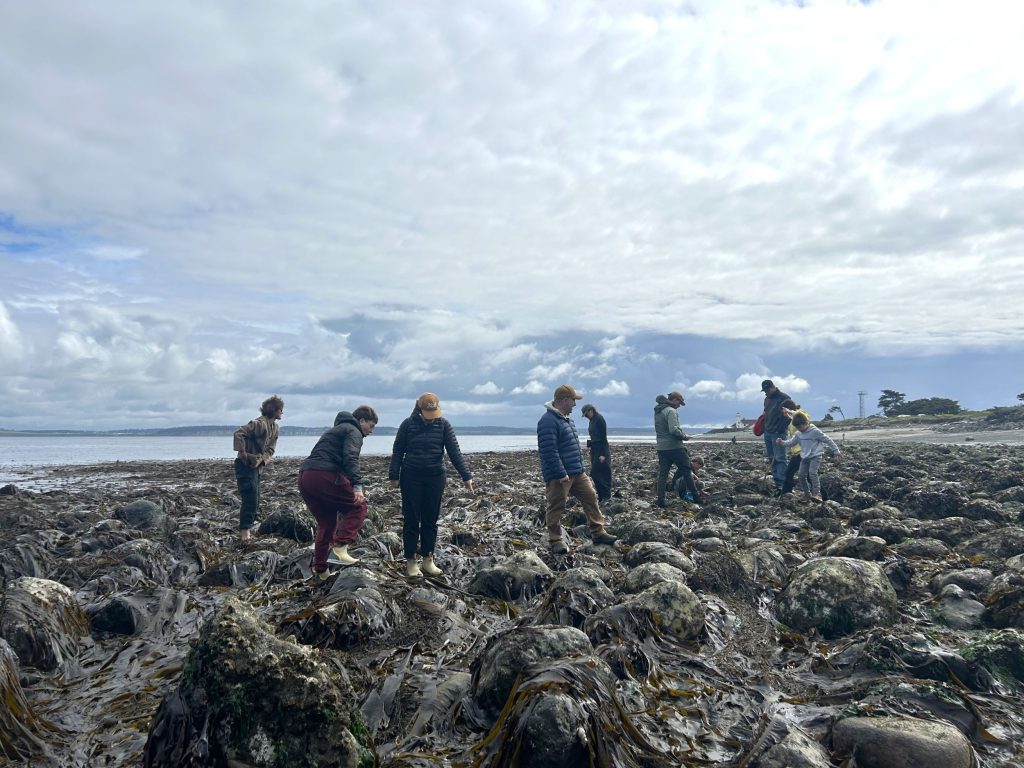
As you near, small pops of color begin to show themselves. The bright neon green of Ulva, a type of green seaweed. The penetratingly black shiny shells of Mytilus trossulus – mussels- contrasting the brilliantly white fortresses the acorn barnacles have created on the rocks – Balanus glandula. Suddenly you hear a yell-
“Woah, come look at this!”

The excitement of the unknown takes over, and you make your way as quickly as possible while navigating the dangerous maze of slippery seaweed, sharp barnacles, and squishy anemones. A small group of people are crouched around a boulder, peering at the underside.
“What is it?” You ask, skeptical that the answer is worth the traverse it took. A volunteer answers, “If you come around to this side and crouch down, you can see a burrowing sea cucumber; they are bright orange and red!”
Sure enough, out of the previously monotonous browns and dull greens, a small circle, about as big as a quarter, painted a bright traffic cone orange, appears beneath the rock.
“That’s a sea cucumber?” You ask incredulously; it looks nothing like the photos you’ve seen online of the long orange-ish, red-ish thing covered in spikes that actually looks like the food cucumber.

This is just one example of the exciting finds that a Low Tide Walk with the Port Townsend Marine Science Center can offer. Living things that are normally suspended in many feet of water can look alien-like and blobish when, all of a sudden, they are without water, making them difficult to identify as the marine animals we know from underwater photographs. This is where our experienced educators, naturalists, and volunteers can really make your low tide experience one to remember. With ID guides in hand, we will come to any call, holler, or excited yelp to help you identify the surprisingly colorful, squishy, and previously unseen wonders of the intertidal zone.
Other finds include:

Fish that have been stranded by the tide (don’t worry, they can survive until the tide comes back, as long as we don’t touch them!)
A rainbow of sea stars, big and small, purple, orange, red, and grey-blue. Perhaps you will get lucky and find one feeding on a bed of mussels.

Sea slugs!
Try finding a sea lemon or sea mouse, you might even encounter a leopard printed one, or one I call the tic-tac sea slug, almost always on a red sponge since it has the same stop-sign red color.


And so much more!
Almost every part of a rock that is normally covered by the ocean has something living on it that you can identify with our volunteers and ID guides. From things that attach themselves to the rock like seaweeds (most are edible!), sponges, bryozoans, and tunicates, to things that can move like chitons, snails, slugs, and crabs, there is so much to explore on even just one boulder.
If you’ve never heard of some of these groups of organisms, that’s another great reason to come out and experience the low tide with PTMSC! These walks can be educational and entertaining for all ages, whether you’ve lived by the Salish Sea your whole life or have recently arrived here; I can almost guarantee you will come away having seen a new organism or learned something new.
The best way to experience the low tide is not only being informed, but being prepared. So, bring sun protection, reusable water bottles, and closed-toe shoes that have good traction on the slippery rocks – as well as your curiosity and questions. Whether the sun is glistening on the water or the grey clouds are sprinkling lightly on its surface, we hope to see you out there!
Find dates and registration for upcoming Low Tide Walks here.